D.Pharma vs B.Pharma vs Pharm.D After 12th
D.Pharma, B.Pharma, and Pharm.D, all three sound similar, right? That’s the biggest confusion students face after 12th PCB today.
Everyone says pharmacy has scope, but nobody tells you which pharmacy course is actually right for your future. You're choosing between courses randomly, as you don't fully understand. Consequently, you can't know what will happen or when it will happen.
Not a great idea at all…
We understand that to kick-start their career, students want a quick job. Some dream of working in hospitals or multinational pharmaceutical companies. While others want a stable healthcare career without spending years preparing for medical entrance exams.
But, when they start researching pharmacy courses after 12th, they get stuck between three major options, i.e., D.Pharma vs B.Pharma vs Pharm D After 12th. One course is shorter, another opens numerous career opportunities, while the third focuses heavily on clinical practice and patient care.
You can find solutions in this guide only. So, stay tuned till the end.
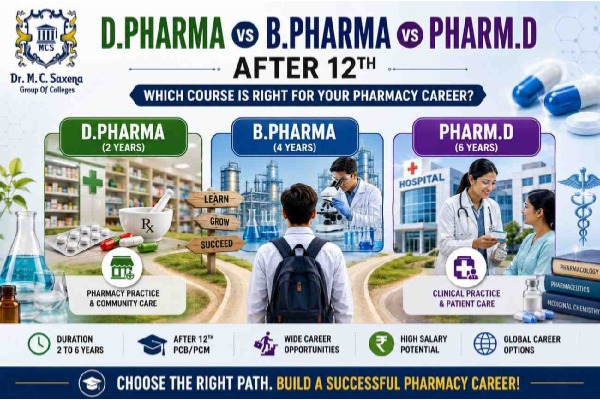
Quick Pharmacy Courses Comparison After 12th
Take a quick glimpse at the 3 major pharmacy courses after 12th:
|
Factor |
D.Pharma |
B.Pharma |
Pharm.D |
|
Duration |
2 years |
4 years |
6 years (5+1) |
|
Full Form |
Diploma in Pharmacy |
Bachelor of Pharmacy |
Doctor of Pharmacy |
|
Eligibility |
12th pass |
12th pass |
12th pass |
|
Course Type |
Diploma/Vocational |
Bachelor's Degree |
Professional Doctorate |
|
Focus |
Practical skills |
Theory + Practical |
Clinical expertise |
|
Job Entry |
2 years |
4 years |
6 years |
|
Starting Salary |
₹2-3 LPA |
₹3-4.5 LPA |
₹4-6 LPA |
|
Maximum Salary |
₹6-8 LPA |
₹12-15 LPA |
₹20+ LPA |
|
Job Options |
Community pharmacy |
Industry, research |
Clinical, healthcare |
|
International Scope |
No |
Limited |
Yes |
Why Pharmacy is the Most Preferred Career After 12th?
The healthcare industry never stops growing, and this is quite evident in most research. For instance, in the India Brand Equity Foundation (IBEF) report, it is mentioned that India’s pharmaceutical industry is expected to reach $130 billion by 2030:
Moreover, after the COVID-19 pandemic, the demand for qualified pharmacy professionals increased in hospitals, pharmaceutical companies, research labs, drug manufacturing units, clinical research organizations, healthcare startups, and retail pharmacy chains.
That’s why students are now actively exploring a career in pharmacy after 12th instead of relying only on traditional medical degrees.
What is D.Pharma After 12th?
D.Pharma (Diploma in Pharmacy) is a 2-year vocational program that prepares students for practical pharmacy skills and drug dispensing techniques. This could be an ideal choice for candidates who want a quick start in their pharmacy career.
Ideally, it gives hands-on training experience so that an individual can become a community pharmacist immediately after completion and start making money.
D Pharma after 12th: Course Duration + Structure
- Total Duration: 2 years and 4 semesters.
- Theory and Practical: 40% theory and 60% practical.
- Teaching Method: Includes classroom lectures and job training.
- Eligibility: 12th pass from any stream.
- Age: No age restriction.
Read More : B.Pharmacy vs D.Pharmacy
Curriculum
|
Year 1 (Semester 1 and 2) |
Year 2 (Semester 3 and 4) |
|
Pharmaceutical Chemistry I and II |
Pharmacology and Toxicology |
|
Pharmacognosy and Phytochemistry |
Pathophysiology and Disease Management |
|
Pharmaceutics and Dosage Forms |
Pharmaceutical Jurisprudence and Regulatory Affairs |
|
Pharmacy Practice and Ethics |
Pharmacy Management and Business Economics |
|
Biochemistry and Anatomy-Physiology |
Clinical Pharmacy and Patient Counseling |
|
Pharmaceutical Calculations and Measurement |
Advanced Pharmaceutics and Compounding |
Scope of D Pharma
The career scope of D Pharma after 12th and salary expectations could be:
- Registered Pharmacist: ₹2.5 LPA to ₹4.5 LPA.
- Medical Store Manager: ₹2 LPA to ₹4 LPA.
- Hospital Pharmacy Assistant: ₹1.8 LPA to ₹3.5 LPA.
- Drug Distributor: ₹3 LPA to ₹6 LPA.
- Healthcare Sales Executive: ₹2.5 LPA to ₹5 LPA.
- Pharmacy Technician: ₹2 LPA to ₹4 LPA.
- Quality Control Technician: ₹3 LPA to ₹5 LPA.
- Warehouse Manager: ₹3.5 LPA to ₹6 LPA.
Read More : D.Pharm vs B.Pharm Salary After 5 Years
Choose D Pharma After 12th If You:
- Want to earn within 2 years.
- Want to have hands-on experience over theoretical knowledge.
- Dream of owning your own pharmacy business.
- Have a limited budget for education.
- If you have entrepreneurial skills.
Understanding B.Pharma After 12th
B.Pharma (Bachelor of Pharmacy) is a 4-year undergraduate degree that can help you enter the Pharmacy sector in the Medical and Health Care Industry. This course combines pharmaceutical chemistry, pharmacology, pharmaceutics, and clinical knowledge. However, this is the major difference between D Pharma and B Pharma.
There is a famous saying in the pharmaceutical industry, which goes like, “B.Pharm is the golden ticket to the pharmaceutical world”.
Course Duration and Structure
- Total Duration: 4 years and 8 semesters.
- Theory and Practical Percentage: 50% theory, 40% practical, and 10% project work included.
- Teaching Method: Classroom + Laboratory + Industry visits + Project work.
- Eligibility: 12th pass (science stream preferred).
- Admission: NEET, State entrance exams, or Merit-based.
Curriculum
|
Year 1 (Semester 1 and 2) |
Year 2 (Semester 3 and 4) |
Year 3 (Semesters 5 and 6) |
Year 4 (Semesters 7 and 8) |
|
Pharmaceutical Chemistry I and II |
Pharmaceutical Chemistry III |
Pharmaceutical Chemistry IV (Medicinal Chemistry) |
Advanced Pharmaceutical Technology |
|
Pharmacognosy and Phytopharmacy |
Pharmacology I and Toxicology |
Pharmacology II and Drug Development |
Clinical Pharmacy and Therapeutics |
|
Pharmaceutics I (Dosage Form Basics) |
Pharmaceutics II (Advanced Dosage Forms) |
Pharmaceutics III (Biopharmaceutics) |
Pharmacy Management and Hospital Administration |
|
Biochemistry and Human Anatomy |
Pharmacognosy II and Natural Products |
Pharmaceutical Jurisprudence and Ethics |
Pharmaceutical Biotechnology |
|
Physiology and Health Promotion |
Pharmaceutical Analysis |
Quality Assurance and Regulatory Affairs |
Industrial Pharmacy and Cosmetics |
|
Pharmaceutical Calculations |
Pathophysiology and Therapeutics |
Pharmacognosy III and Research Methods |
Research Project / Internship / Industry training |
Scope of B Pharma
The scope of B Pharma is quite wider because graduates can work in:
- Pharmaceutical Industry (Production, Quality, R&D): ₹3 LPA to ₹6 LPA
- Research and Development Scientist: ₹4 LPA to ₹8 LPA
- Regulatory Affairs Officer: ₹4 LPA to ₹7 LPA
- Quality Assurance Manager: ₹5 LPA to ₹10 LPA
- Clinical Pharmacist (limited): ₹3 LPA to ₹5 LPA
- Hospital Pharmacist (medium-level): ₹2.5 LPA to ₹5 LPA
- MedicalRepresentative (senior level): ₹3 LPA to ₹7 LPA + incentives
- Pharmacovigilance Officer: ₹4 LPA to ₹8 LPA
- Drug Inspector (government): ₹6 LPA to ₹10 LPA
- Pharmaceutical Consultant: ₹5 LPA to ₹12 LPA
- Academic Faculty (colleges): ₹3.5 LPA to ₹7 LPA
- Clinical Trials Officer: ₹4 LPA to ₹7 LPA
- MedicalWriting and Documentation: ₹3.5 LPA to ₹6 LPA
|
Fun Fact 😮: As per the All India Pharmaceutical Manufacturers Association (AIPMA) 2024, there is an 85-90% B.Pharma placement rate in pharmaceutical companies. |
B.Pharma is the Right Choice If You…
- Want career options in industry, research, government, and academics.
- Interested in pharmaceutical industry jobs.
- Aim for government jobs like a drug inspector.
- Pursue higher education (M.Pharma, PhD) later.
Understanding Pharm.D After 12th
When comparing D.Pharma vs B.Pharma vs Pharm D after 12th, the Pharm.D is a pharmacy program that prepares students for clinical roles. Doctor of pharmacy is a 6-year (5 years academics + 1 year clinical practice) and is the highest pharmacy qualification.
It is very different from B Pharma after 12th, which is industry- and production-focused, because Pharm D focuses on clinical practice and patient interaction.
Course Duration and Structure
- Total Duration: 6 years (5 academic + 1 internship).
- Total Credit Hours: 3,000+ contact hours.
- Theory, Practical, and Clinical Structure: 35% of the course will be focused on theoretical knowledge, 30% will be practical sessions, and 35% clinical training will be provided.
- Teaching Method: Includes classroom learning, laboratory experiences, hospital rotations, and clinical case studies.
- Eligibility: Candidate must be a 12th pass from the science stream.
- Age Limit: Below 30 years.
- Admission: NEET / Entrance exam (highly competitive).
Curriculum
|
Year 1 (Semesters 1-2) |
Year 2 (Semesters 3-4) |
Year 3 (Semesters 5-6) |
Year 4 (Semesters 7-8) |
Year 5 (Semesters 9-10) |
Year 6 (Internship/Practice Year) |
|
Pharmaceutical Chemistry I and II |
Pharmaceutical Chemistry III and IV |
Clinical Pharmacy I (Fundamentals) |
Clinical Pharmacy II (Patient-Centered Care) |
Clinical Pharmacy III (Advanced Cases) |
Hospital Pharmacy Practice (3-4 months) |
|
Pharmacognosy and Ethnopharmacy |
Pharmacology I and II |
Pharmaceutics III (Advanced Technologies) |
Pharmacotherapy I (Disease Management) |
Pharmacotherapy II (Specialized Therapeutics) |
Clinical Pharmacy Rotation (3-4 months) |
|
Pharmaceutics I (Dosage Forms) |
Pharmaceutics II (Drug Delivery Systems) |
Medicinal Chemistry and Drug Design |
Pharmaceutical Research and Biostatistics |
Pharmaceutical Biotechnology and Personalized Medicine |
Community Pharmacy Practice (1-2 months) |
|
Biochemistry and Molecular Biology |
Pharmacognosy II and Natural Products Research |
Pathophysiology and Therapeutics II (Specialized) |
Advanced Pharmacology and Molecular Pharmacology |
Drug Development and Clinical Trials |
Specialized Clinical Rotations — Cardiology, Oncology, Pediatrics, etc. |
|
Human Anatomy and Physiology |
Pathophysiology and Therapeutics I |
Pharmacognosy III and Phytochemistry |
Quality Assurance and Quality Control |
Pharmacy Practice Management |
- |
|
Pharmaceutical Calculations |
Pharmaceutical Analysis and Bioanalysis |
Pharmaceutical Jurisprudence and Regulatory Affairs |
Social and Administrative Pharmacy |
Research Thesis / Capstone Project |
- |
Scope of Pharma.D
The scope of Pharm.D is highly patient-focused, and most importantly, it is globally recognised. Thus, it opens doors for advanced healthcare and clinical career opportunities like:
- Clinical Pharmacist: ₹4 LPA to ₹8 LPA
- Hospital Pharmacist: ₹3.5 LPA to ₹6 LPA
- Medical Writer: ₹4 LPA to ₹7 LPA
- Clinical Research Associate: ₹4 LPA to ₹8 LPA
- Drug Safety Associate: ₹4 LPA to ₹7 LPA
- Medical Writer and Documentation Specialist: ₹4 LPA to ₹8 LPA
- Government Healthcare System Officer: ₹5 LPA to ₹10 LPA
- International Healthcare Organizations: ₹8 LPA to ₹20 LPA
Pharm. D Suits Students Who Want
- Ambitious about career and want the highest salary.
- Want international career opportunities (USA, UK, Middle East).
- Interested in clinical research and healthcare innovation.
- Want a WHO-recognized global qualification.
Final Words
Social pressure, rising education costs, and fear of making the “wrong decision” often cause students to feel completely lost. Plus, the confusion hits hard. Pharmacy courses after 12th are not one-size-fits-all. D.Pharma, B.Pharma, and Pharm.D each serve different career goals.
The question isn’t about which course is best for you. You need to tweak it a bit and ask, “Which course is best for YOUR goals?” Once you answer that honestly, your path becomes clear.
FAQs
Q1: Which is better, D Pharma or B Pharma after 12th?
A: B Pharma offers broader career options, while D Pharma is suitable for a shorter course and quicker entry.
Q2: Which is better, B Pharma or Pharm D?
A: B Pharma is better for pharma industry careers, while Pharm D focuses more on clinical and hospital roles.
Q3: Which pharmacy course is best after 12th?
A: It depends on your goal. D Pharma is shorter, B Pharma offers wider options, and Pharm D focuses on clinical pharmacy.
Q4: What is the difference between D Pharma, B Pharma and Pharm D?
A: They differ in duration, qualification, course structure and career opportunities.
Q5: Can I do B Pharma after D Pharma?
A: Yes, eligible D Pharma students can apply for B Pharma through lateral entry, subject to admission rules.
Q6: Which has better career scope: D Pharma, B Pharma or Pharm D?
A: B Pharma generally offers broader career options, while D Pharma and Pharm D have more specific career paths.
Q7: How long are D Pharma, B Pharma and Pharm D?
A: D Pharma is generally 2 years, B Pharma 4 years and Pharm D 6 years.